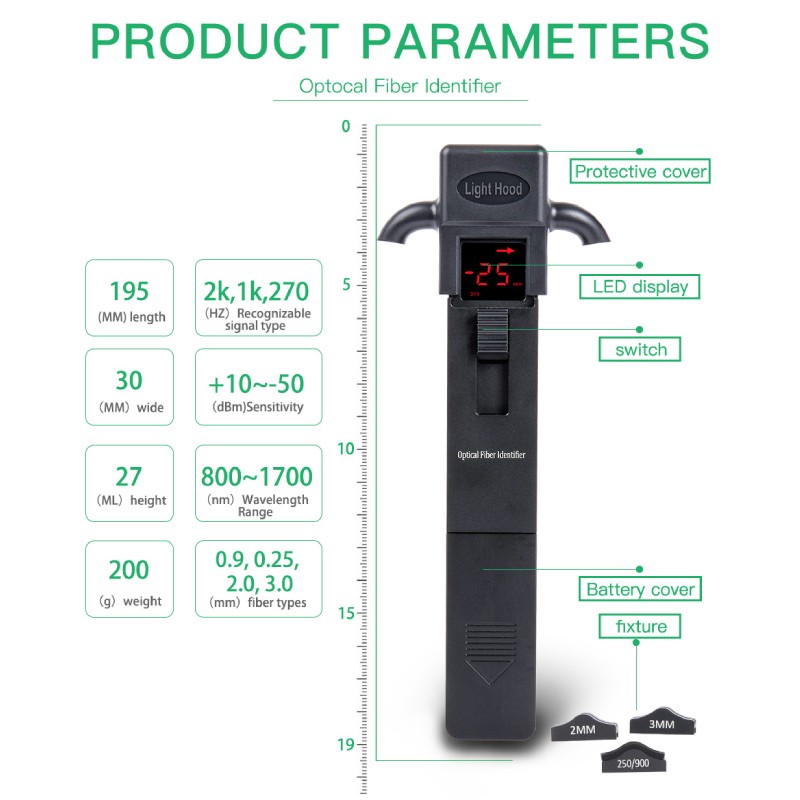
Optical Fiber Identifier K-350
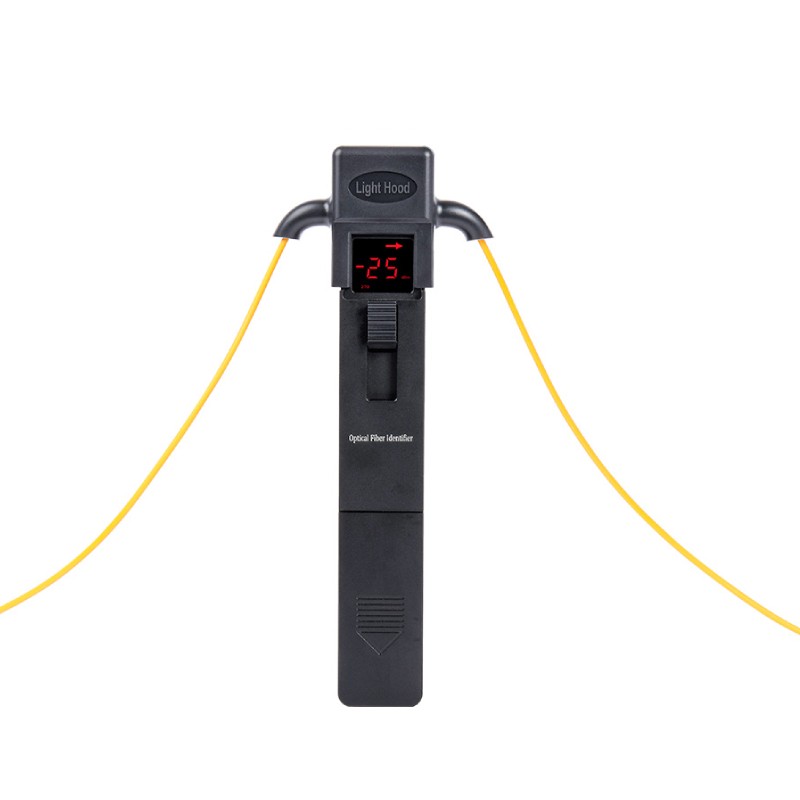
Clamp it on a live fiber and it tells you — without cutting anything — whether light is there, which way it travels, how strong it runs, and whether it carries a tone.
Typical work: Finding the one live fiber in a tray or closure full of identical cords — before anything is unplugged; Confirming traffic direction on working links during maintenance windows; Tracing a fiber end-to-end with a 270 Hz / 1 kHz / 2 kHz tone from a light source at the far end; Checking relative core power on a live circuit without taking it out of service; FTTH and metro maintenance where the wrong disconnection drops a paying customer.
Get a Quote WhatsApp UsNeutral stock in small lots, or private label made to your requirements. Prices on request — EXW factory pricing.
K-350 key features
- It answers the four questions of live-fiber work in one clamp-on: is there light, which way is it going (the arrow LEDs), how strong is it (the relative core power on the display), and is it carrying a tone — all without cutting, unplugging or bending the fiber past what it can take
- Tone recognition is how fibers get found: put a 270 Hz, 1 kHz or 2 kHz modulation on the far end with your light source, and the K-350 picks that exact fiber out of a crowded tray — the tone sounds continuous, while plain traffic beeps intermittently, so the two can never be confused
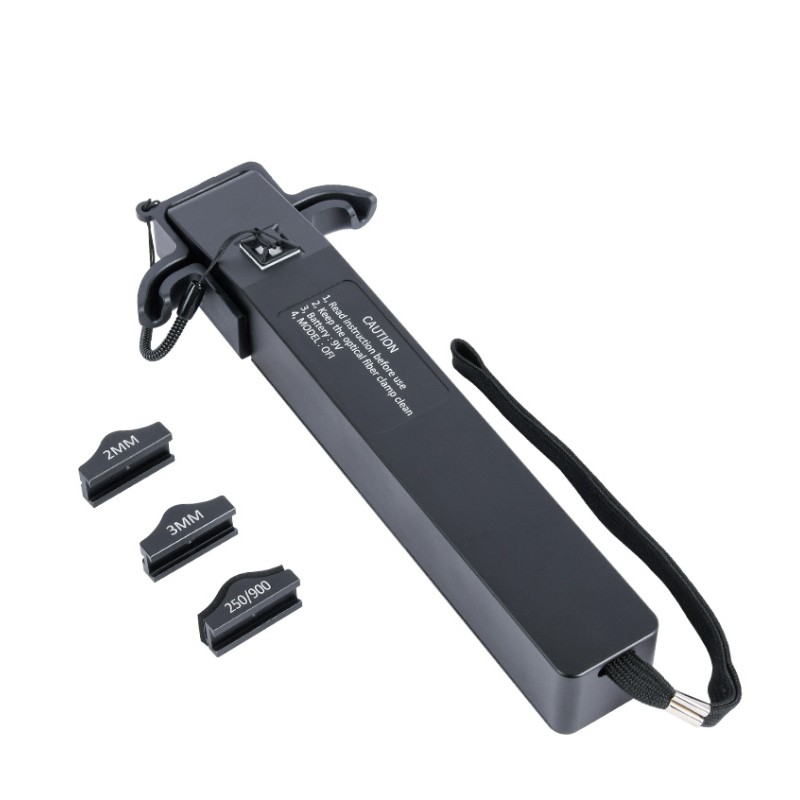
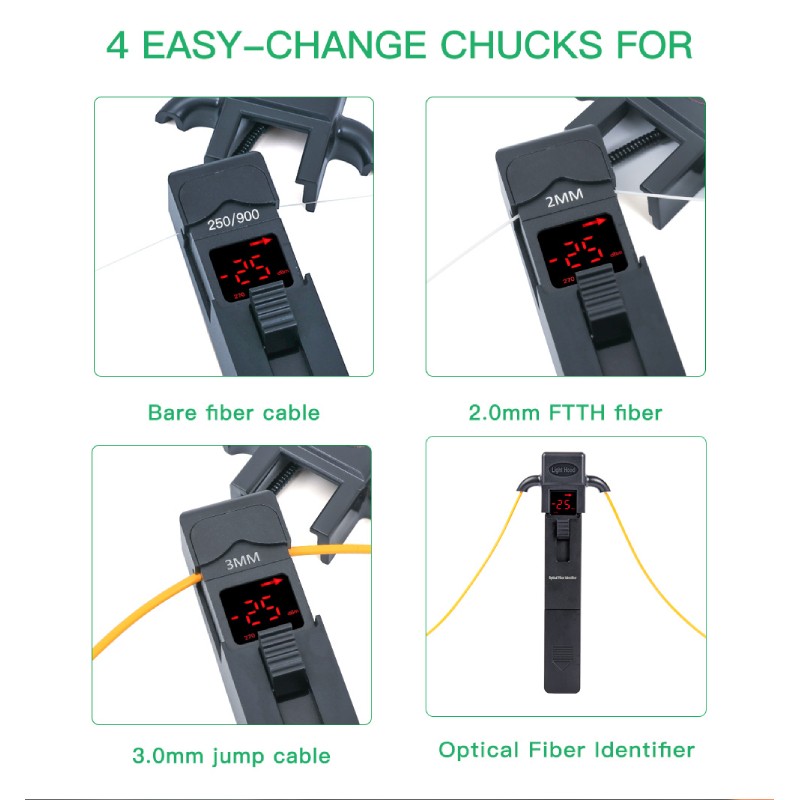
- Four easy-change chucks cover the fiber as it actually appears on site: Ø0.25 bare fiber, Ø0.9 tight-buffered, Ø2.0 FTTH cord and Ø3.0 jumper — the chuck matches the coating, so the macro-bend the detector needs is firm on a jumper and gentle on bare glass
- Real sensitivity where it matters: direction reading down to -50 dBm at 1550 nm and -46 dBm at 1310 nm on bare fiber, across an 800–1700 nm identification range — post-splitter FTTH levels are well inside its working window
- The typical insertion loss is printed honestly — 0.8 dB at 1310 nm, 2.5 dB at 1550 nm — because clamping a detector onto a live circuit is a measurement the circuit feels; knowing the number is what lets you use it on a working link with confidence
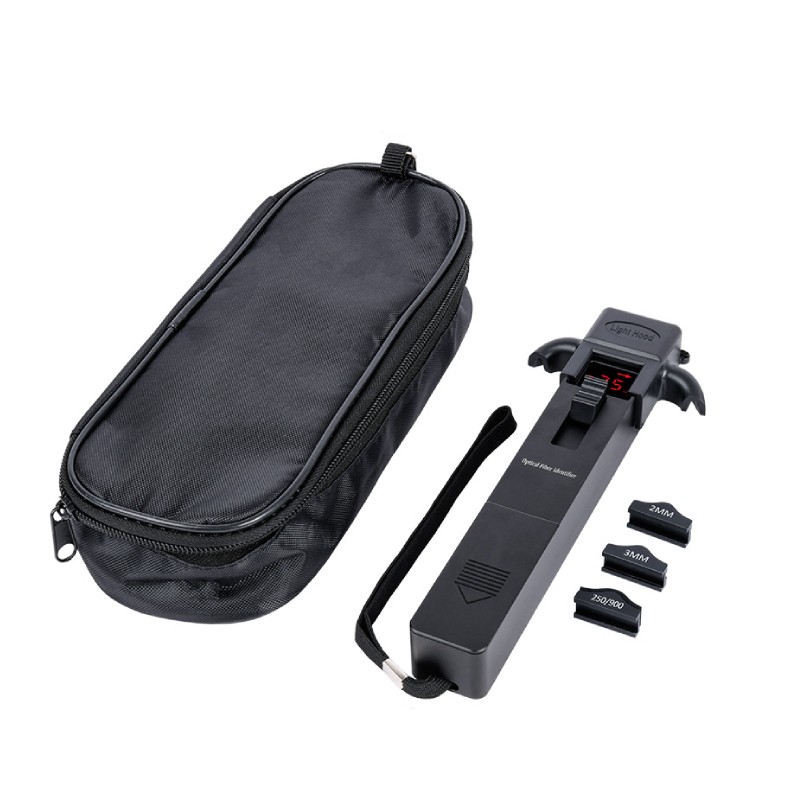
- A 9 V battery, a light hood over the clamp for bright plant rooms, and a soft case with the chucks and wrist strap: one grab-and-go kit at 200 g, with nothing to configure before the first reading
- Private labeling made to your requirements — labels with your logo, part numbers and barcodes on the inner boxes and outer cartons, ready for your warehouse
K-350 specifications
| Identified wavelength range | 800–1700 nm |
|---|---|
| Identified signal types | CW, 270 Hz, 1 kHz, 2 kHz (±5%) |
| Detector | Ø1 mm InGaAs × 2 |
| Adapter heads | Four easy-change chucks: Ø0.25 (bare fiber), Ø0.9, Ø2.0, Ø3.0 |
| Signal direction | Left / right LED arrow indication |
| Direction test range (CW, 0.9 mm bare fiber) | -46 to +10 dBm (1310 nm); -50 to +10 dBm (1550 nm) |
| Relative core power range | -50 to +10 dBm (CW, 0.9 mm bare fiber) |
| Frequency test range (Ø0.9 / 2.0 / 3.0 heads) | -30 to 0 dBm (270 Hz, 1 kHz); -25 to 0 dBm (2 kHz) |
| Insertion loss (typical) | 0.8 dB (1310 nm); 2.5 dB (1550 nm) |
| Audible indication | Intermittent tone when traffic is present; continuous tone on a recognised modulation |
| Power supply | 9 V alkaline battery |
| Operating temperature | -10 °C to +60 °C |
| Storage temperature | -25 °C to +70 °C |
| Dimensions | 196 × 30.5 × 27 mm |
| Weight | 200 g |
How It Works — reading light through a bend
An optical fiber identifier listens at a bend. Clamping the fiber into the head imposes a controlled macro-bend — just enough that a small fraction of the light escapes through the coating, where two Ø1 mm InGaAs detectors sit waiting. Because the light leaks in the direction of travel, comparing the two detectors tells the instrument which way the signal flows; that is the arrow on the display. Nothing is cut, nothing is disconnected, and the fiber springs back when the clamp opens.
The number on the display is relative core power: not an absolute dBm measurement like a power meter gives, but a true indication of how much light this fiber carries compared with its neighbours — enough to tell a live fiber from a dark one, a strong feed from a fading one, and the toned fiber from forty silent lookalikes. For absolute levels, clamp off and use a power meter; for finding and proving, the identifier is the tool that never takes a circuit down.
Tone work is the daily use case. A light source at the far end modulated at 270 Hz, 1 kHz or 2 kHz marks its fiber; the identifier recognises the modulation and sounds a continuous tone, while unmodulated traffic produces an intermittent beep. In a splice tray with dozens of identical yellow cords, that difference is the whole job: sweep the clamp along the bundle and stop at the one that sings steadily.
Technique notes: seat the fiber fully in the chuck that matches its coating — a 3.0 mm jumper in the bare-fiber chuck bends too hard, and bare fiber in the 3.0 chuck may not bend enough to read. Keep the light hood closed in bright rooms, since stray light is the one thing a leak detector cannot tell from signal. And remember the insertion loss: brief clamping for identification is the intended use, not a permanent tap.
Compare the fiber test equipment range
Every product in this category, side by side on the figures that decide the choice. Blank cells mean the figure is not stated in our current data — ask us and we will confirm it for the model you mean.
| K-527 | K-V10 | K-PV1 | K-340 | K-350 | K-535 | |
|---|---|---|---|---|---|---|
| Wavelength | — | 650 ± 10 nm (visible red) | — | — | — | — |
| Measurement range | -70 to +10 dBm | — | -70 to +10 dBm | — | — | -70 to +6 dBm or -50 to +26 dBm (two versions) |
| Dimensions | — | 175 × 26 × 26 mm | — | 219 × 45 × 28 mm | 196 × 30.5 × 27 mm | 118 × 72 × 32 mm |
| Weight | — | 53 g (excluding batteries) | — | 235 g | 200 g | 150 g |
Where the K-350 works
Finding the one live fiber in a tray or closure full of identical cords — before anything is unplugged
Part of the Fiber Test Equipment range — see the specifications above for the figures that matter on this work.
Confirming traffic direction on working links during maintenance windows
Part of the Fiber Test Equipment range — see the specifications above for the figures that matter on this work.
Tracing a fiber end-to-end with a 270 Hz / 1 kHz / 2 kHz tone from a light source at the far end
Part of the Fiber Test Equipment range — see the specifications above for the figures that matter on this work.
Checking relative core power on a live circuit without taking it out of service
Part of the Fiber Test Equipment range — see the specifications above for the figures that matter on this work.
FTTH and metro maintenance where the wrong disconnection drops a paying customer
Part of the Fiber Test Equipment range — see the specifications above for the figures that matter on this work.
K-350 components
- One K-350 optical fiber identifier
- Four adapter chucks (Ø0.25, Ø0.9, Ø2.0, Ø3.0)
- Soft carry case
- Wrist strap
Documents for this model
Product Catalog 2026 — this model appears in our full-range catalog (PDF), published in the Downloads center.
User manual — if you need the manual for this model now, ask via the inquiry form below or on WhatsApp and we will send the available documents with your quote.
More fiber test equipment
Questions about the K-350
Can the K-350 carry our own brand?
Private labeling is made to your requirements and confirmed per order — labels with your logo, part numbers and barcodes on the tools, the inner boxes and the outer cartons, ready for your warehouse. The products most often labeled are the K-35 cleaver, the KS-1 Kevlar shears and the K-870 stripper.
Can we order a small lot, unbranded?
Yes. Neutral stock is held for the core range: small lots are welcome, you can mix models in one shipment, and restock as you sell. Prices are on request — EXW factory pricing.
Ask for a quote — K-350
Tell us the quantity, and whether you want it neutral or with your brand on it.