Optical Fiber Identifier K-340
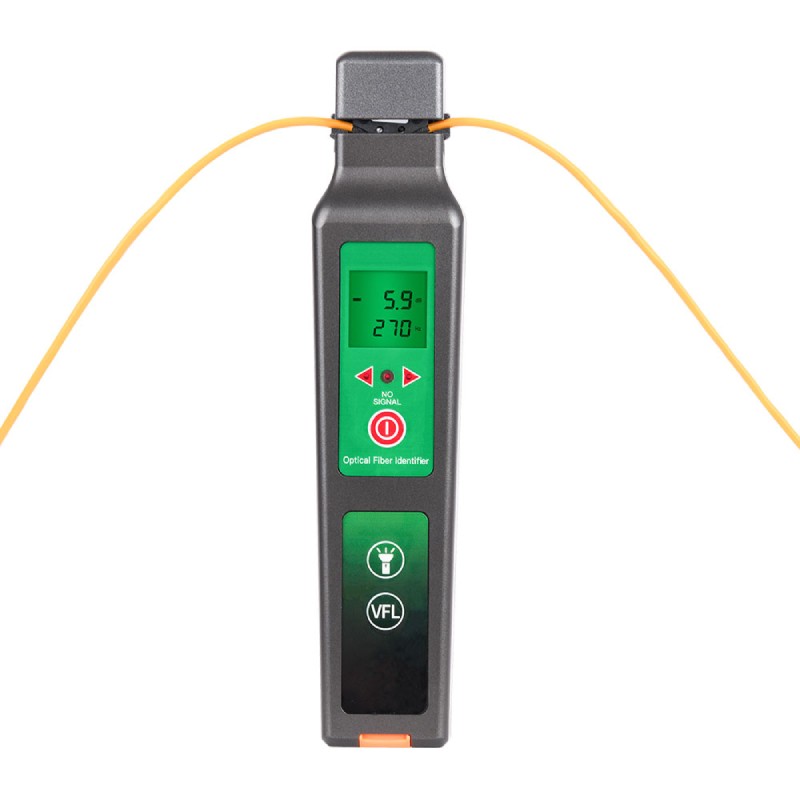
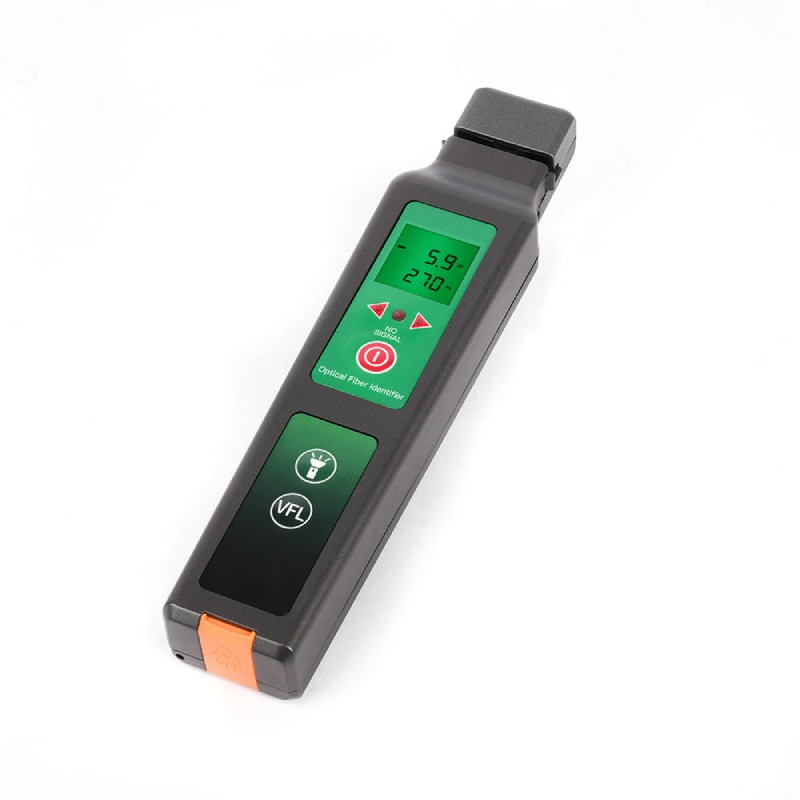
The identifier that also finds faults: clip-on live-fiber identification with a universal holder, plus a built-in 10 mW VFL and an LED work light for the dark corners of the cabinet.
Typical work: Identifying live fibers in FTTH and metro maintenance — presence, direction and relative power without a disconnection; Tracing a toned fiber (270 Hz / 1 kHz / 2 kHz) through trays and closures; Fault-finding straight from the same tool: the 10 mW VFL shows breaks and bad bends as a visible red glow; Working inside dark cabinets and closures — backlit display plus a built-in LED work light; Crews who want one instrument on the belt instead of an identifier, a VFL pen and a torch.
Get a Quote WhatsApp UsNeutral stock in small lots, or private label made to your requirements. Prices on request — EXW factory pricing.
K-340 key features
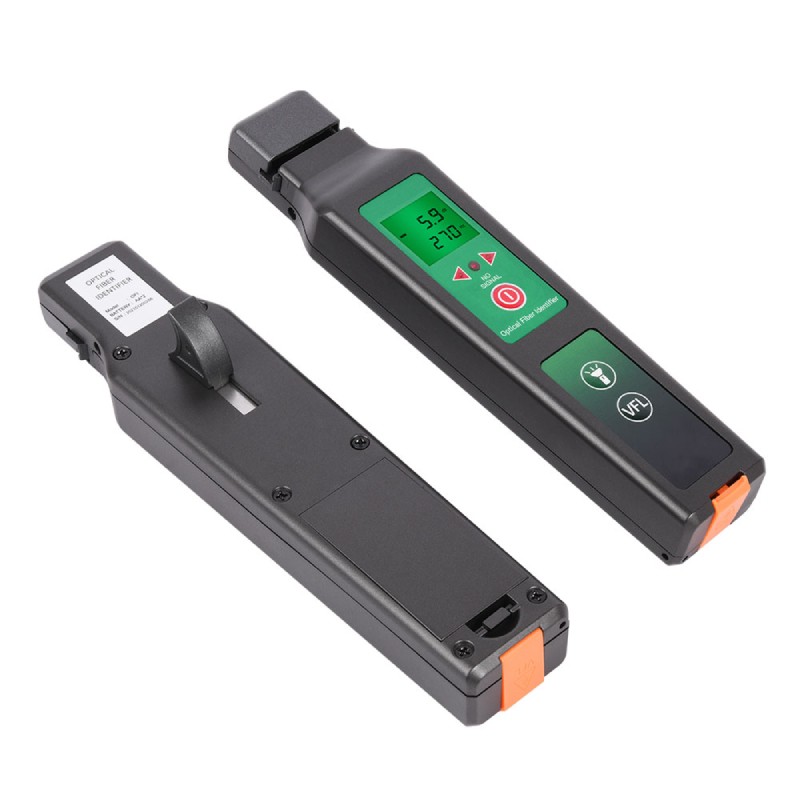
- Three instruments share this housing: the identifier reads live fiber, the built-in 10 mW visual fault locator (650 nm, 2.5 mm universal connector, 8–10 km reach) finds the break or the crushed bend the reading pointed at, and an LED work light covers the cabinet corners where both jobs happen in the dark
- No chucks to change: one universal multi-in-one fixture takes Ø0.25 bare fiber, Ø0.9, Ø2.0 and Ø3.0 cable as it comes — the swap-and-lose-a-chuck step disappears, and so does the pause while the right chuck is found at the bottom of a tool bag
- The display does the talking: relative power from -40 to +10 dBm and the recognised tone on a backlit LCD, direction on the arrow LEDs, and a NO SIGNAL indicator that says the fiber is dark without ambiguity — readable at arm's length, in a dark closure, without a headlamp
- Tone recognition at 270 Hz, 1 kHz and 2 kHz for end-to-end tracing: modulate the far end, then sweep the bundle until this one answers — identification and fault location in a single visit, on a circuit that never comes down
- Plastic housing, honestly specified: the lighter, lower-cost build (219 × 45 × 28 mm, 235 g) is the point of this model — two AA batteries power the identifier, the VFL and the light, so the belt kit stays one tool and one battery type
- Private labeling made to your requirements — labels with your logo, part numbers and barcodes on the inner boxes and outer cartons, ready for your warehouse
K-340 specifications
| Identified wavelength range | 800–1700 nm |
|---|---|
| Identified signal types | CW, 270 Hz, 1 kHz, 2 kHz (±5%) |
| Detector | Ø1 mm InGaAs × 2 |
| Fiber holder | Universal multi-in-one fixture — Ø0.25 (bare), Ø0.9, Ø2.0, Ø3.0, no chuck changes |
| Signal direction | Left / right LED arrow indication, with NO SIGNAL indicator |
| Optical power reading range | -40 to +10 dBm |
| Display | LCD with LED backlight |
| VFL output | 10 mW, 650 nm (LD), 2.5 mm universal connector |
| VFL range | 8–10 km |
| LED work light | Built in |
| Housing | Plastic |
| Power supply | 2 × AA batteries |
| Operating temperature | -10 °C to +60 °C |
| Storage temperature | -25 °C to +70 °C |
| Dimensions | 219 × 45 × 28 mm |
| Weight | 235 g |
How It Works — identification, then fault-finding, in one tool
The identifier works like every macro-bend detector: the fiber sits in the universal fixture under a controlled bend, a fraction of the light escapes, and two Ø1 mm InGaAs detectors compare what leaks on each side — the stronger side is where the light comes from, which the arrows report. The reading on the LCD is the fiber's relative power, and the tone detector listens for the 270 Hz, 1 kHz or 2 kHz modulation a source at the far end would add.
The universal fixture is this model's working difference: instead of swapping chucks per coating, one holder geometry centres 0.25, 0.9, 2.0 and 3.0 mm fiber alike. On a tray of mixed cords — a 3.0 jumper here, a 0.9 pigtail there — the tool moves from fiber to fiber without a pause, which is exactly when identification gets done properly instead of sampled.
When the identifier says the fiber is live but wrong — weak, or dark past a point — the same tool switches jobs: the VFL button launches 10 mW of 650 nm red light into the fiber through the 2.5 mm universal connector, and the fault glows through the jacket at the break or the tight bend, visible across a dark cabinet. Identification located the circuit; the VFL locates the fault on it.
Field notes: the NO SIGNAL lamp is a result, not an error — it means the clamped fiber carries nothing the detectors can see. Keep the fixture faces clean, since the bend geometry is the measurement; and the LED light is for working, not for inspecting connector end-faces — that still wants a microscope.
Compare the fiber test equipment range
Every product in this category, side by side on the figures that decide the choice. Blank cells mean the figure is not stated in our current data — ask us and we will confirm it for the model you mean.
| K-527 | K-V10 | K-PV1 | K-340 | K-350 | K-535 | |
|---|---|---|---|---|---|---|
| Wavelength | — | 650 ± 10 nm (visible red) | — | — | — | — |
| Measurement range | -70 to +10 dBm | — | -70 to +10 dBm | — | — | -70 to +6 dBm or -50 to +26 dBm (two versions) |
| Dimensions | — | 175 × 26 × 26 mm | — | 219 × 45 × 28 mm | 196 × 30.5 × 27 mm | 118 × 72 × 32 mm |
| Weight | — | 53 g (excluding batteries) | — | 235 g | 200 g | 150 g |
Where the K-340 works
Identifying live fibers in FTTH and metro maintenance — presence, direction and relative power without a disconnection
Part of the Fiber Test Equipment range — see the specifications above for the figures that matter on this work.
Tracing a toned fiber (270 Hz / 1 kHz / 2 kHz) through trays and closures
Part of the Fiber Test Equipment range — see the specifications above for the figures that matter on this work.
Fault-finding straight from the same tool: the 10 mW VFL shows breaks and bad bends as a visible red glow
Part of the Fiber Test Equipment range — see the specifications above for the figures that matter on this work.
Working inside dark cabinets and closures — backlit display plus a built-in LED work light
Part of the Fiber Test Equipment range — see the specifications above for the figures that matter on this work.
Crews who want one instrument on the belt instead of an identifier, a VFL pen and a torch
Part of the Fiber Test Equipment range — see the specifications above for the figures that matter on this work.
K-340 components
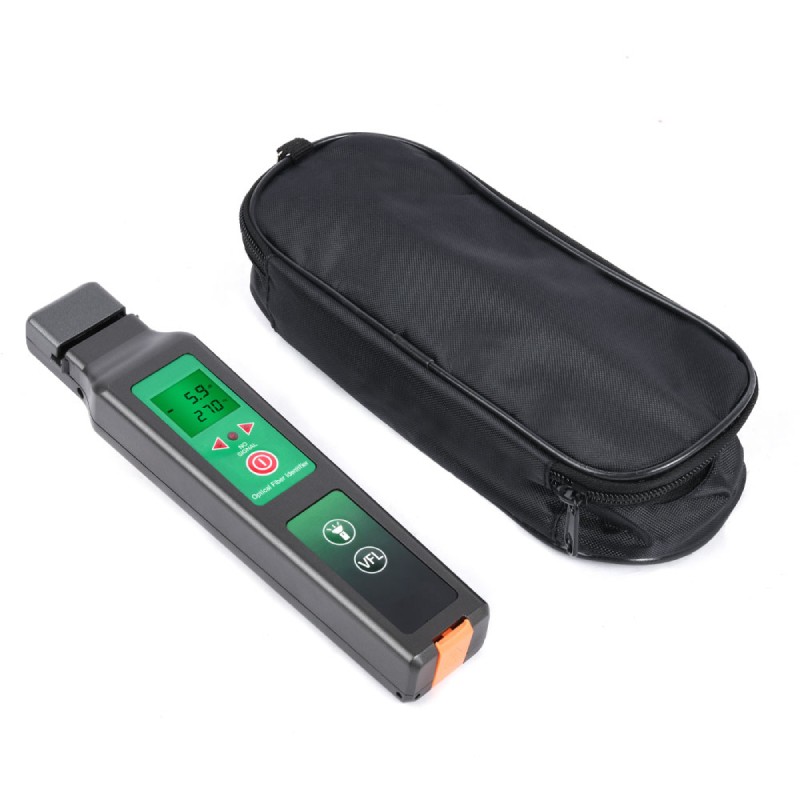
- One K-340 optical fiber identifier
- Soft carry case
Documents for this model
Product Catalog 2026 — this model appears in our full-range catalog (PDF), published in the Downloads center.
User manual — if you need the manual for this model now, ask via the inquiry form below or on WhatsApp and we will send the available documents with your quote.
More fiber test equipment
Questions about the K-340
Can the K-340 carry our own brand?
Private labeling is made to your requirements and confirmed per order — labels with your logo, part numbers and barcodes on the tools, the inner boxes and the outer cartons, ready for your warehouse. The products most often labeled are the K-35 cleaver, the KS-1 Kevlar shears and the K-870 stripper.
Can we order a small lot, unbranded?
Yes. Neutral stock is held for the core range: small lots are welcome, you can mix models in one shipment, and restock as you sell. Prices are on request — EXW factory pricing.
Ask for a quote — K-340
Tell us the quantity, and whether you want it neutral or with your brand on it.