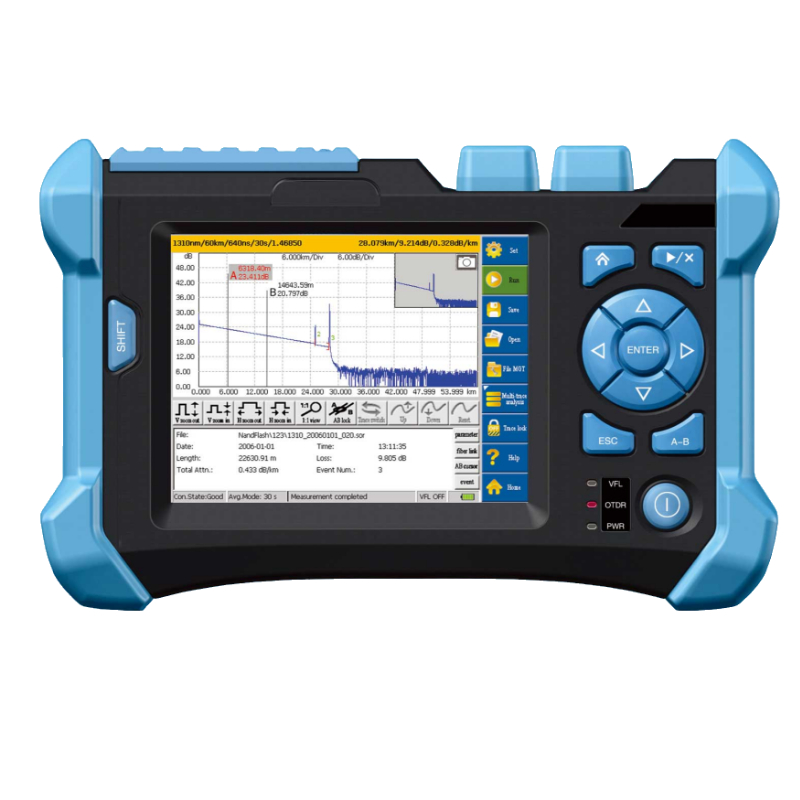
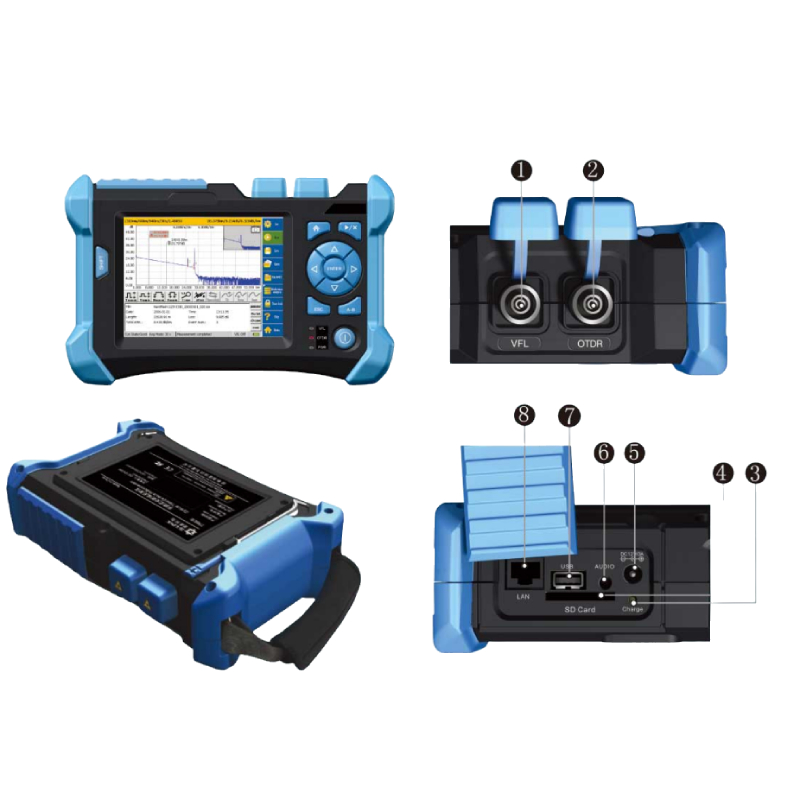
OTDR K-600
A platform OTDR for FTTx, metro and backbone work: choose the wavelength set and dynamic range the network needs, read it on a 5.6-inch touch screen, and keep more than 10,000 traces on the SD card.
Typical work: FTTx and PON acceptance testing — verifying splitters, drops and splice points before handover; Metro and backbone construction: certifying new spans and archiving reference traces; Fault location on live networks — breaks, bends and bad connectors found from one end; Live-fiber monitoring with the 1625 nm configuration, clear of the traffic wavelengths; Periodic maintenance comparison of today's trace against the as-built reference.
Get a Quote WhatsApp UsNeutral stock in small lots, or private label made to your requirements. Prices on request — EXW factory pricing.
K-600 key features
- Configurations, not compromises: single-mode 1310/1550 nm at 32/30, 38/36 or 40/38 dB, triple-wavelength 1310/1490/1550 nm for PON work, a 1625 nm build for live-fiber monitoring, and multimode 850/1300 nm — one platform, specified per order
- Short dead zones for dense plant: event dead zone at or under 1.8 m and attenuation dead zone at or under 10 m, so connectors and splices packed into a cabinet or closure still separate on the trace
- Fast in the field: 0.2 s typical real-time refresh, intelligent one-touch testing, measurement times from 5 seconds to 3 minutes, and a built-in 650 nm VFL (up to 3 km) for the short visible checks
- Built to be carried: dustproof, shockproof casing at 1.5 kg, a lithium battery good for eight hours or more, and traces stored on SD card and moved over USB or Ethernet
K-600 specifications
| Wavelength options | 850/1300 nm (multimode); 1310/1550 nm; 1310/1490/1550 nm; 1625 nm |
|---|---|
| Dynamic range | Up to 40/38 dB (1310/1550 nm) — by build; see the model table |
| Pulse width | 5–20480 ns (single-mode); 5–1280 ns (multimode) |
| Event dead zone | ≤1.8 m |
| Attenuation dead zone | ≤10 m |
| Display | 5.6 in LCD touch screen |
| Linearity | ±0.05 dB/dB |
| Loss threshold | 0.05 dB |
| Loss resolution | 0.001 dB |
| Sampling resolution | 0.125–8 m |
| Sampling points | 32K |
| Distance uncertainty | ±(1 m + 5×10⁻⁵ × distance + sampling interval) |
| Distance range | 0.3–180 km |
| Real-time refresh | 0.2 s (typical) |
| Trace storage | SD card (16 G), >10,000 traces |
| Measurement duration | 5 s, 10 s, 15 s, 30 s, 1 min, 2 min, 3 min (selectable) |
| Optical interface | FC/UPC (PC and APC selectable) |
| Data interfaces | USB, SD card, Ethernet |
| Built-in VFL | 650 nm, ≥-3 dBm, max. testing distance 3 km |
| Battery | Lithium battery, ≥8 h continuous working |
| Dimensions | 150 × 235 × 66 mm |
| Weight | 1.5 kg |
| Operating temperature | -10 °C to +50 °C |
| Storage temperature | -30 °C to +70 °C |
| Relative humidity | 0–95% (non-condensing) |
How an OTDR read works — and where the K-600 earns its keep
The OTDR sends a pulse of light down the fiber and listens to what comes back: a faint reflection from every connector and mechanical splice, the steady backscatter of the glass itself, and a hard spike at a break or the fiber end. Plotted against distance, that returning light becomes the trace — slope for attenuation, steps and spikes for events — and the instrument turns it into a table of lengths, losses and fault positions without anyone visiting the far end.
Two numbers decide whether close-together events can be told apart: the event dead zone (≤1.8 m here) and the attenuation dead zone (≤10 m). In a distribution cabinet where connectors sit centimetres apart, a long dead zone hides the second connector inside the first one's tail; the K-600's short zones keep them separate. Range is the other trade: pulse width runs from 5 ns for fine detail to 20480 ns for reach, and the distance scope tops out at 180 km — pick the configuration whose dynamic range covers the link budget, because an oversized OTDR buys range you will never use at the cost of the close-up resolution you need every day.
Choose your K-600 model
One platform, several builds. Pick the wavelength set and dynamic range for your network, and quote the model code with your inquiry — we confirm the build and lead time with your quote.
| Model | Wavelengths | Fiber | Dynamic range | VFL |
|---|---|---|---|---|
| K-600-M1 | 850/1300 nm | Multimode | 20/18 dB | Built-in |
| K-600-M2 | 850/1300 nm | Multimode | 23/21 dB | Built-in |
| K-600-S1 | 1310/1550 nm | Single-mode | 32/30 dB | Built-in |
| K-600-S2 | 1310/1550 nm | Single-mode | 38/36 dB | Built-in |
| K-600-S3 | 1310/1550 nm | Single-mode | 40/38 dB | Built-in |
| K-600-P1 | 1310/1490/1550 nm | Single-mode | 32/30/30 dB | Built-in |
| K-600-P2 | 1310/1490/1550 nm | Single-mode | 36/34/34 dB | Built-in |
| K-600-L1 | 1310/1550/1625 nm | Single-mode | 32/30/28 dB | — |
| K-600-L2 | 1310/1550/1625 nm | Single-mode | 38/36/34 dB | — |
| K-600-C1 | 850 + 1310/1550 nm | Multimode + single-mode | 22/30/28 dB | — |
| K-600-C2 | 850/1300 + 1310 nm | Multimode + single-mode | 20/18/30 dB | — |
| K-600-C3 | 850 + 1310/1550 nm | Multimode + single-mode | 25/30/28 dB | — |
| K-600-C4 | 850/1300 + 1310 nm | Multimode + single-mode | 23/21/30 dB | — |
| K-600-C5 | 850/1300 + 1310/1550 nm | Multimode + single-mode | 20/18/30/28 dB | — |
Where the K-600 works
FTTx and PON acceptance testing — verifying splitters, drops and splice points before handover
Part of the Fusion Splicers & Connection range — see the specifications above for the figures that matter on this work.
Metro and backbone construction: certifying new spans and archiving reference traces
Part of the Fusion Splicers & Connection range — see the specifications above for the figures that matter on this work.
Fault location on live networks — breaks, bends and bad connectors found from one end
Part of the Fusion Splicers & Connection range — see the specifications above for the figures that matter on this work.
Live-fiber monitoring with the 1625 nm configuration, clear of the traffic wavelengths
Part of the Fusion Splicers & Connection range — see the specifications above for the figures that matter on this work.
Periodic maintenance comparison of today's trace against the as-built reference
Part of the Fusion Splicers & Connection range — see the specifications above for the figures that matter on this work.
K-600 components
- One K-600 OTDR (configuration as ordered)
- Lithium battery (fitted)
- Power adapter / charger
- SD card
- Carry case
Documents for this model
Product Catalog 2026 — this model appears in our full-range catalog (PDF), published in the Downloads center.
User manual — if you need the manual for this model now, ask via the inquiry form below or on WhatsApp and we will send the available documents with your quote.
More fusion splicers & connection
Questions about the K-600
Can the K-600 carry our own brand?
Private labeling is made to your requirements and confirmed per order — labels with your logo, part numbers and barcodes on the tools, the inner boxes and the outer cartons, ready for your warehouse. The products most often labeled are the K-35 cleaver, the KS-1 Kevlar shears and the K-870 stripper.
Can we order a small lot, unbranded?
Yes. Neutral stock is held for the core range: small lots are welcome, you can mix models in one shipment, and restock as you sell. Prices are on request — EXW factory pricing.
Ask for a quote — K-600
Tell us the quantity, and whether you want it neutral or with your brand on it.